The Rules of the Dreidel Game
The Rules of the Dreidel Game: A Complete Guide
What four-letter word can keep a roomful of children (and adults) entertained for an entire evening while simultaneously teaching them about Jewish history? If you guessed the four Hebrew letters on a dreidel, you are right. The dreidel game is one of the most iconic and beloved Chanukah traditions, combining simple fun with deep historical meaning. Whether you are playing for the first time or looking to brush up on the rules, this guide has everything you need.
What Is a Dreidel?
A dreidel (Yiddish: dreydl; Hebrew: sevivon) is a four-sided spinning top. Each side is marked with a Hebrew letter: Nun, Gimel, Hei, and Shin. Together, these letters form an acronym for the phrase Nes Gadol Hayah Sham, meaning "A great miracle happened there," referring to the miracle of the oil in the Holy Temple in Jerusalem.
In Israel, the dreidel is slightly different. The Shin is replaced with a Pei, and the acronym becomes Nes Gadol Hayah Po, meaning "A great miracle happened here," since the miracle took place in the land of Israel itself.
The History Behind the Dreidel
According to a beloved tradition, the dreidel dates back to the time of the Chanukah story itself. When the Greek-Syrian rulers outlawed the study of Torah, Jewish children continued to study in secret. If soldiers approached their hiding places, the children would quickly conceal their scrolls and pull out spinning tops, pretending to be merely playing games. The dreidel thus became a symbol of Jewish resilience and the determination to preserve Torah learning even under the harshest conditions.
Historically, the spinning top game may have originated from similar European games, such as the German Trendel or the English teetotum. Jews adopted and transformed the game, infusing it with Jewish meaning and connecting it to the Chanukah story. Regardless of its exact origins, the dreidel has become inseparable from the holiday.
What You Need to Play
A dreidel: You can buy one at any Judaica store, or make one as a craft project. Dreidels come in wood, plastic, metal, and even chocolate.
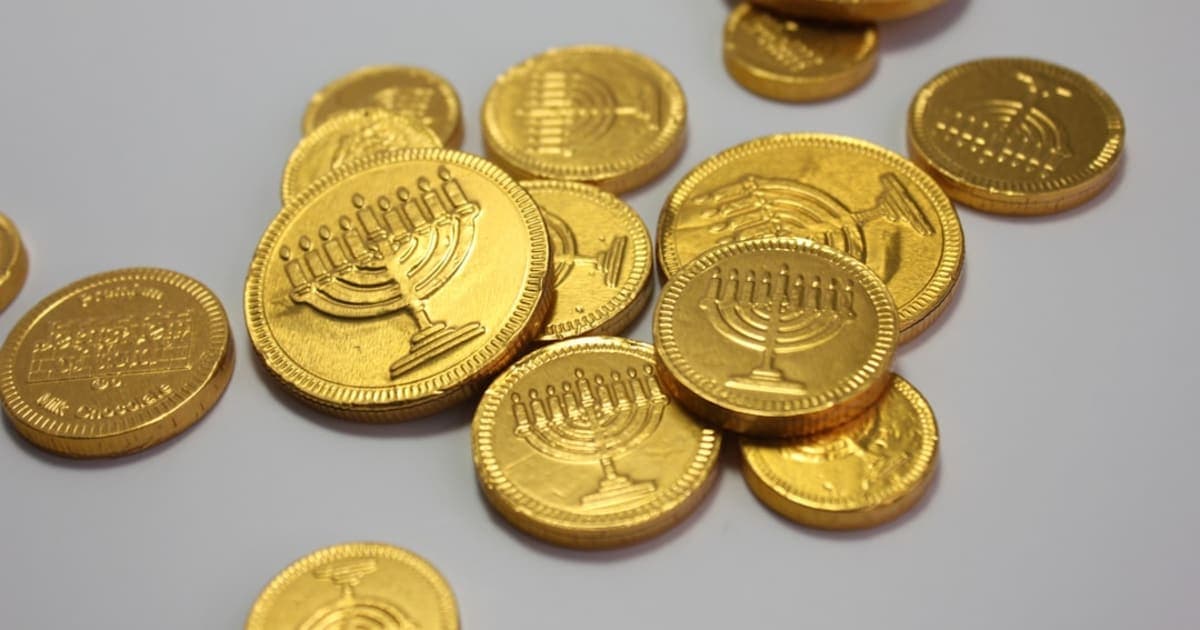
Game pieces: Traditionally, players use chocolate gelt (coins), nuts, raisins, candies, or real coins. Each player should start with an equal number, usually 10 to 15 pieces.
Players: Two or more. The more players, the more fun.
The Complete Rules
Setup
1. Each player receives an equal number of game pieces (10 to 15 is typical).
2. Before each round, every player puts one game piece into the center "pot" (also called the "kupah" or "kitty").
3. Choose who goes first. You can take turns spinning to see who gets the highest letter, or simply let the youngest player start.
How to Spin
Hold the dreidel by its stem between your thumb and forefinger. Give it a firm twist and release. When the dreidel falls, the letter facing up determines your action for that turn.
The Four Letters and Their Actions
Nun (N) - Nisht (Nothing): The player does nothing. The turn passes to the next player.
Gimel (G) - Gantz (All): The player takes the entire pot. After a Gimel, every player must put one piece back into the pot before the next spin.
Hei (H) - Halb (Half): The player takes half the pot. If there is an odd number of pieces, the player takes half rounded up.
Shin (Sh) - Shtel (Put in): The player must add one piece to the pot.
Continuing the Game
Play continues clockwise around the group.
Whenever the pot is empty or has only one piece left, every player puts one piece in before the next spin.
If a player runs out of game pieces, they have two options depending on your house rules: they can borrow one piece from another player, or they are out of the game.
Winning the Game
The game ends when one player has won all the game pieces, or when players agree to stop. In practice, most dreidel games end when the latkes are ready or when bedtime arrives, whichever comes first.
Strategy Tips
The dreidel is a game of chance, so there is no guaranteed strategy. However, here are some tips to keep the fun going:
Manage your pieces: Try not to go all-in early. Keep a reserve so you can stay in the game longer.
Watch the pot: The size of the pot changes constantly. A big pot makes a Gimel spin very exciting, and a Shin spin less painful.
Play with food: Using chocolate gelt, candies, or nuts as game pieces means that even losing is sweet. Plus, you get to snack during the game.
Set a time limit: Dreidel games can theoretically go on indefinitely. Setting a time limit keeps the energy up.
Variations and House Rules
Like many family games, dreidel has countless variations. Here are some popular ones:
Speed dreidel: Everyone spins at the same time. The letter facing up when all dreidels have stopped determines each player's action simultaneously.
Tournament style: Play multiple rounds. The winner of each round gets a point. The player with the most points at the end of the evening wins a special prize.
Giving dreidel: Instead of winning pieces for yourself, each Gimel or Hei spin means you get to give pieces to the player of your choice. This version emphasizes the Chanukah value of generosity.
Double or nothing: Landing on Gimel twice in a row means you win double the pot. Landing on Shin twice means you put in double. High stakes, high drama.
Making Dreidel Meaningful
Beyond the game itself, the dreidel carries powerful symbolism. Consider sharing these ideas while you play:
The four letters remind us that the Chanukah miracle was real and significant. Every spin is a mini-declaration of faith.
The dreidel spins and wobbles, sometimes landing on fortune (Gimel) and sometimes on loss (Shin). Life works the same way, and the dreidel teaches us to take both in stride.
The tradition of children studying Torah in secret, using dreidels as a cover, reminds us that Jewish learning is precious enough to risk everything for.
The dreidel game is more than just a pastime. It is a living connection to the Chanukah story, a way to bring families together, and a reminder that even in play, there are lessons to be learned. So gather your chocolate gelt, grab a dreidel, and let the spinning begin.
For more about the holiday, see our complete guide to What Is Chanukah? and learn about lighting the menorah and pirsumei nisa.